Stories built civilizations long before screens existed. They still build children — even in homes filled with tablets, smartphones, and family TVs. Here’s how Muslim parents can use both wisely.
Stories and screens can coexist in a Muslim child’s life. The real issue isn’t screens themselves — it’s unsupervised, algorithm-driven content that replaces emotional connection with passive consumption.
Storytelling — especially Islamic storytelling — gives children something screens cannot: memory rooted in emotion, values absorbed through narrative, and a faith identity that lasts beyond childhood.
Why Stories Stay With Children Longer Than Videos
Ask any Muslim adult to recall a story their parents told them at age six. Most can. Now ask them what cartoon they watched at the same age. Most struggle to remember even one in detail.
This isn’t accidental. Research in developmental psychology consistently shows that narrative memory outlasts passive visual memory. When a child watches a fast-cut video, the brain processes visual information but doesn’t deeply encode it. When a child listens to a story, the brain constructs images, emotions, sounds, and consequences — building a mental world the child becomes part of.

Stories also activate something videos rarely do: anticipation. A child waiting to find out what happens next is engaged differently than a child consuming the next autoplaying clip. One is participating. The other is being served.
The science in one line: Emotion is the strongest known driver of long-term memory. Stories carry emotion. Most short-form video does not.
Parents concerned about modern digital habits should also understand how YouTube impacts children’s attention span and emotional development.
Why Allah Teaches Through Stories
Look closely at the Quran and a pattern emerges: Allah teaches through narrative, not lectures. Entire surahs are devoted to the lives of prophets — their struggles, their patience, their moments of doubt, their eventual triumphs. There is a reason for this.
“There was certainly in their stories a lesson for those of understanding.” — Quran 12:111
This verse, placed at the end of Surah Yusuf, makes the point explicit. After telling one of the longest continuous stories in the Quran — Prophet Yusuf’s betrayal, slavery, imprisonment, and rise — Allah tells us why the story matters: stories carry lessons that abstract instruction cannot.
For Muslim parents, this is a profound insight. When you struggle to teach your child patience, honesty, or trust in Allah, you are trying to teach something the Quran itself teaches through narrative. The method matters as much as the message.
Parents trying to build stronger Islamic values at home can also explore these Islamic parenting tips for Muslim families.
Prophetic Stories Children Actually Remember
Not all stories work equally well for children. The most memorable prophetic stories are those with clear emotional stakes, a single virtue to learn, and a definite resolution. Here are four that consistently land with Muslim children.
1. Prophet Yusuf (AS) — Patience and Forgiveness
Betrayed by his own brothers, thrown into a well, sold into slavery, falsely accused, imprisoned for years — and yet when Yusuf finally meets his brothers as a powerful man, he says simply: “No blame upon you today.”
Children remember this story because the unfairness feels real to them. Then the forgiveness lands like a thunderclap.
“He said: No blame will there be upon you today. Allah will forgive you; and He is the most merciful of the merciful.” — Quran 12:92
2. Prophet Yunus (AS) — Repentance and Hope
Trapped in the darkness of the whale’s belly, Prophet Yunus called out to Allah — and Allah answered. Children grasp this story instinctively because they know what it’s like to feel stuck. The story teaches them that no situation is so dark that turning to Allah won’t bring light.
3. Prophet Musa (AS) — Courage and Trust in Allah
A baby placed in a basket on a river. A young man fleeing his country. A prophet standing before the most powerful tyrant of his time. Then a sea splitting. Few stories give children a clearer model of doing the right thing even when it’s terrifying.
4. Luqman and his Son — Wisdom and Good Manners
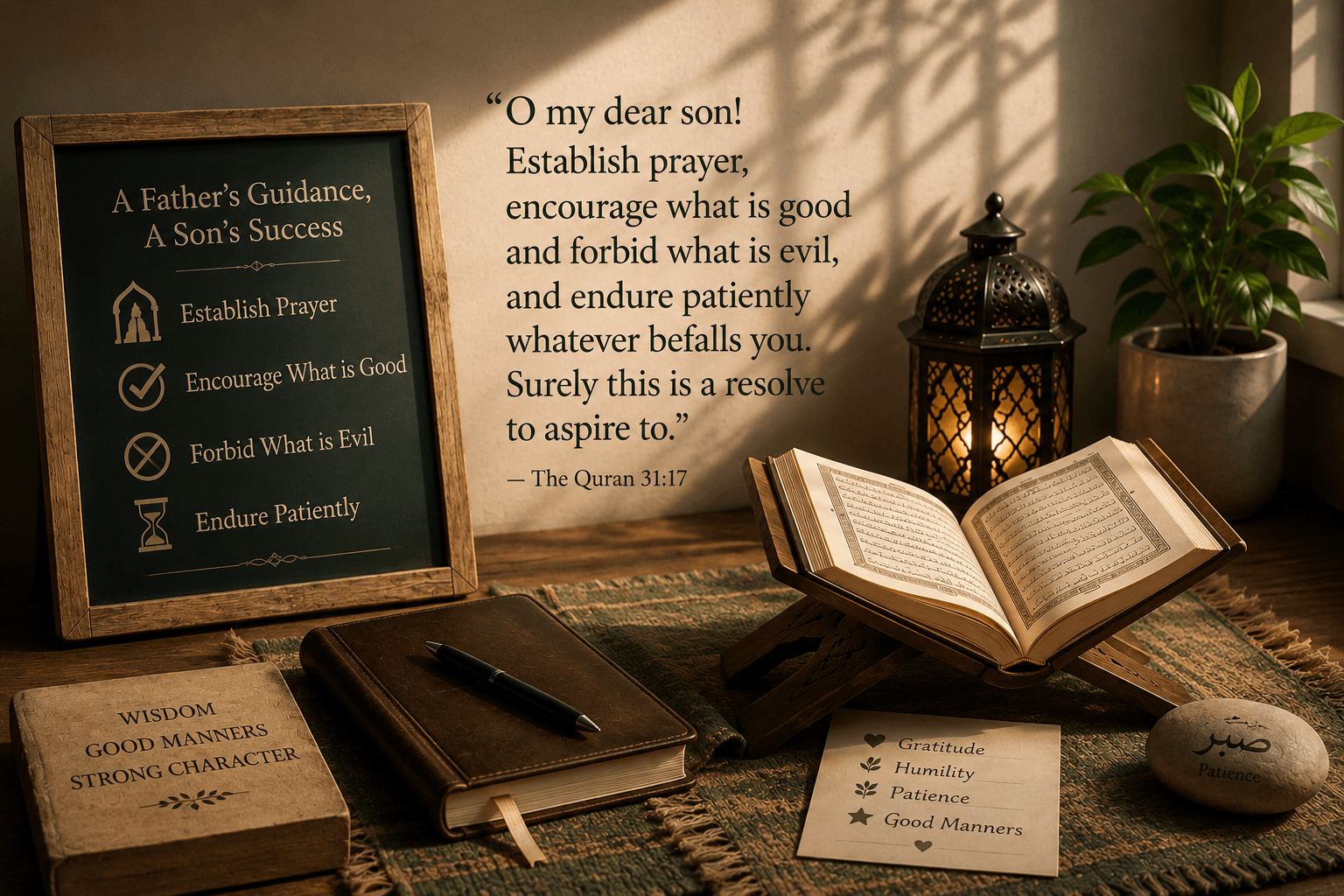
Luqman’s advice to his son is one of the Quran’s most direct parenting passages. He teaches gratitude, prayer, humility, and patience — all in conversation with his child. It models exactly the kind of parenting many of us are reaching for.
“O my dear son! Establish prayer, encourage what is good and forbid what is evil, and endure patiently whatever befalls you. Surely this is a resolve to aspire to.” — Quran 31:17
Screens Aren’t the Enemy — Unsupervised Content Is
Here’s where many parenting articles get this wrong: they treat screens as the villain. They aren’t. A tablet used for Quran reading isn’t the same as TikTok. A phone in reading mode during study isn’t the same as autoplay YouTube before bed.
Modern Muslim parents face a real practical reality. Children use screens for schoolwork. Many homeschooling Muslim families rely on tablets for Islamic studies, language learning, and digital Mushaf access. Family TVs play educational Islamic content. Banning all screens isn’t realistic — and isn’t necessary.
The problem isn’t the device. The problem is what fills the screen and how it’s supervised. Unsupervised algorithmic content — designed by companies whose goal is to maximize watch time, not your child’s character — is what damages attention, sleep, and emotional regulation.
Parents worried about harmful online experiences should learn more about internet safety tips for childrenand ways to protect kids from cyberbullying.
A useful frame: Ask not “is my child on a screen?” but “what’s on the screen, and am I shaping it?” The first question creates guilt. The second creates good parenting.
Stories aren’t a replacement for screens. They are a different kind of input — one that builds different muscles. A healthy Muslim child’s day can include both: stories at bedtime, supervised Quran reading on a tablet, an Islamic cartoon during the afternoon, and quiet reading time without devices.
Parents looking for safer entertainment options can also explore safe online games for kids that support healthier digital habits.
The goal is balance, not avoidance.
A Practical Storytelling Routine for Muslim Families
Storytelling becomes powerful when it becomes routine. Not occasional. Not when you remember. Routine. Here’s how to build one that actually sticks.
When to tell stories
The best moments are bedtime, just after Maghrib prayer, or during family meals. All three share the same feature: the household is calmer and children are emotionally open. Pick one and protect it.
How long stories should be
Ten to fifteen minutes is enough. Children don’t need epic narrations — they need consistent ones. A short story told every night is far more powerful than a long one told occasionally.
By age group
Ages 3–5: Short stories about emotion: kindness, sharing, fairness. Simple Sahabah stories. Repetition matters more than variety.
Ages 6–9: Stories of the prophets with clear moral arcs. Pause and ask: “What would you have done?” Let them imagine.
Ages 10–12: Longer narratives with nuance. Stories of Sahabah, scholars, and historical Muslim figures. Discuss why characters chose what they chose.
Common Mistakes Parents Make
A few patterns sabotage storytelling routines before they take root. Watch for these.
Turning every story into a lecture
Children stop listening the moment a story becomes a sermon. Let the story do the teaching. Trust your child to draw the lesson.
Reading the story instead of telling it
Reading from a book is fine sometimes. But telling a story from memory — making eye contact, changing voice, pausing for drama — engages children at a different level.
Skipping the “boring” parts
Children remember struggle more than triumph. The years Yusuf spent in prison matter as much as his rise to power. Don’t shortcut the difficult middle.
Telling stories only when children misbehave
If stories become a tool for correction, children associate them with shame. Tell them during good times too.
Frequently Asked Questions
Are stories really better than screens for Muslim children?
Stories and supervised screen content can work together. Stories build memory, emotional connection, and faith identity in ways passive video cannot. But screens used in reading mode, for supervised Islamic content, or for study have a legitimate role.
Parents should still be aware of the dangers of unsupervised YouTube for kids and the long-term effects of algorithm-driven content.
Why does the Quran teach through stories?
Allah teaches lessons through stories repeatedly in the Quran because narrative is how human memory and emotion work. Surah Yusuf ends with the statement that
“in their stories is certainly a lesson for those of understanding” (Quran 12:111).
Stories make abstract values tangible. Children remember a story of Prophet Yusuf’s patience long after they forget a lecture on patience.
Which prophetic stories should I tell my Muslim children?
The most emotionally accessible stories are: Prophet Yusuf (patience and forgiveness), Prophet Yunus (repentance and hope), Prophet Musa (courage and trust in Allah), and Luqman’s advice to his son (wisdom and respect for parents). Start with one story per week and let your child ask questions.
How do I make storytelling competitive with TikTok-style content?
You don’t have to. Stories don’t compete on stimulation — they compete on connection and memory. Create a routine where stories happen at a calm time (bedtime, after Maghrib). Use your voice, ask questions, let children imagine. Over time, children begin to look forward to stories the way they look forward to screens — for different reasons.
Parents can also improve their child’s digital environment by learning how to prevent cyberbullying for kids and creating healthier screen boundaries.
At what age should I start telling Islamic stories to my children?
Start as early as age 3 with short, simple stories focused on emotion (kindness, fairness, sharing). Around ages 4–7, introduce stories of the prophets with clear moral lessons. By ages 8–12, children can handle more nuanced stories and start asking deeper questions about faith and character.
Stories Need a Quiet Space to Thrive
If you want storytelling to compete with algorithmic content for your child’s attention, the digital environment around your family needs to support it — not work against it. Kahf Kids gives Muslim families a digital space where Islamic stories, halal content, and parental controls live together.
Learn more at kahfkids.com.