
Every child is an amanah — a trust from Allah. How you raise that child will shape their deen, their character, and their place in the ummah. This guide gives you a clear, practical framework rooted in the Quran and authentic Sunnah.
What Is Positive Islamic Parenting?
Positive Islamic parenting is a holistic, faith-centered approach to raising children that balances love with discipline, guidance with freedom, and authority with compassion — all within the framework of Islam.
It is not permissive parenting that lets children do as they please. Nor is it harsh, fear-based parenting that drives children away from the deen. It is the middle path — the path of the Prophet Muhammad ﷺ, who was the most loving, present, and morally upright parent figure the world has ever known.
At its core, positive Islamic parenting is about:
- Nurturing the fitrah — the innate, Allah-given nature of your child
- Modeling Islamic values at home before teaching them in a classroom
- Building emotional safety so children come to you before they go elsewhere
- Protecting children’s spiritual and digital environment in an age of screens and distraction
- Making dua — because the most powerful parenting tool is supplication
The Prophet ﷺ said: “Every child is born in a state of fitrah — then his parents make him a Jew, a Christian, or a Magian.” (Sahih Bukhari 1385 & Muslim 2658). Your job as a Muslim parent is to protect and nurture that fitrah — not break it.
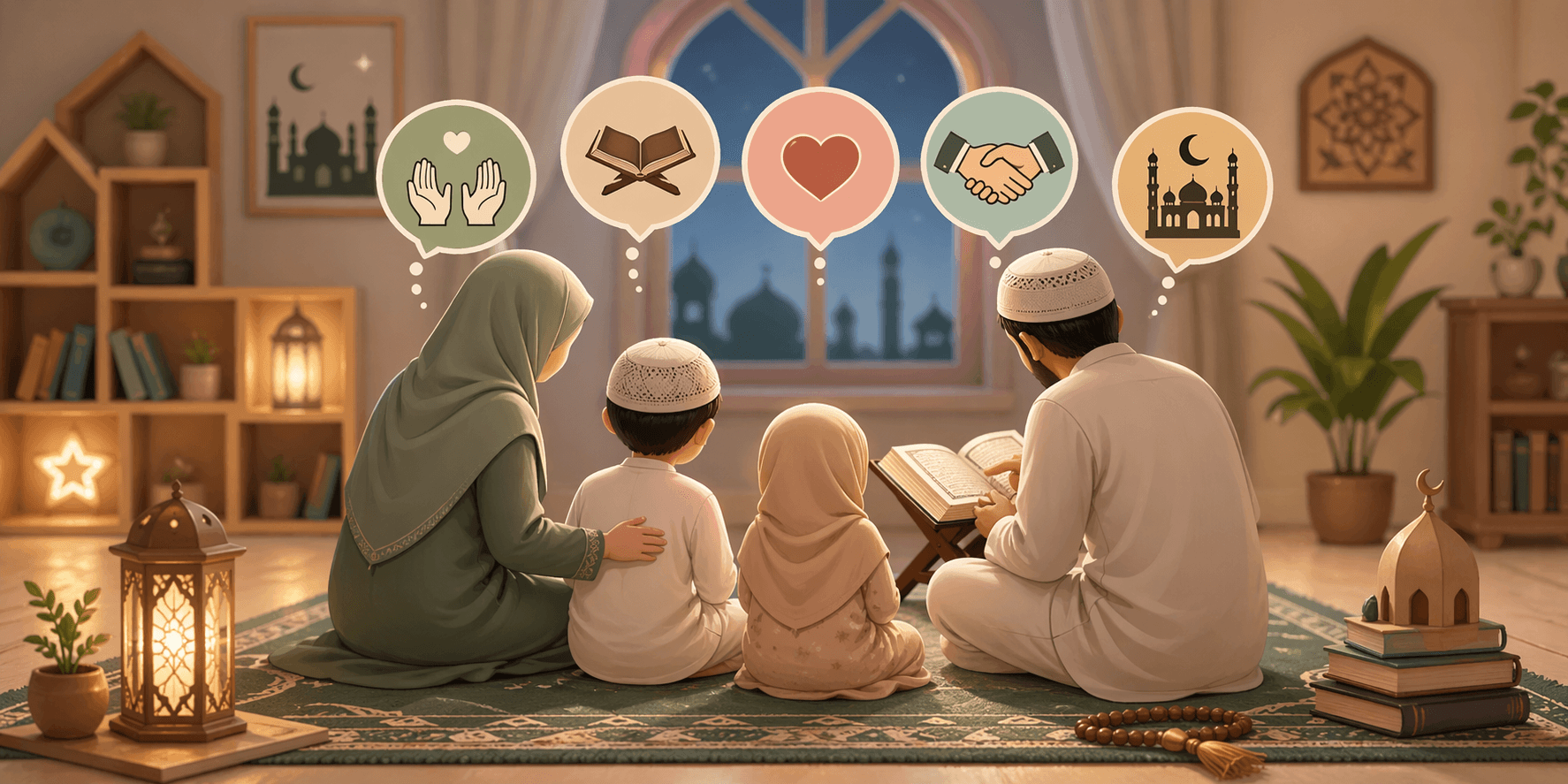
The Islamic Approach to Parenting With Love and Discipline
Many Muslim parents feel torn between two extremes: being too soft or too strict. Islam offers a third way.
Love without discipline produces a child without boundaries. Discipline without love produces a child without connection. The Sunnah shows us a parent-child relationship built on warmth, firmness, presence, and consistent guidance — not fear, shame, or indulgence.
Allah SWT commands us:
“O you who have believed, protect yourselves and your families from a Fire whose fuel is people and stones.” — (Quran 66:6)
Protecting your family means both shielding them from harm and filling their hearts with love, knowledge, and taqwa. One without the other is incomplete.
For a deeper understanding of this balance, watch this beneficial lecture on Islamic parenting with love and discipline, and this talk on practical Islamic parenting in the modern world.
The 10 Principles of Positive Islamic Parenting
What does the Prophet ﷺ actually teach us about raising children? These ten principles offer a clear, authentic answer — rooted in divine guidance and practical enough for everyday family life.
1. Begin With Dua — The Most Powerful Parenting Tool
Before any strategy, before any technique — begin with dua.
The greatest parents in the Quran were people of constant supplication. Prophet Ibrahim (AS) cried out to Allah:
“My Lord, grant me [a child] from among the righteous.” — (Quran 37:100)
And when Allah blessed him with a child, he continued:
“My Lord, make me an establisher of prayer, and [many] from my descendants. Our Lord, and accept my supplication.” — (Quran 14:40)
The Prophet ﷺ confirmed: “Three supplications are answered without doubt: the supplication of the oppressed, the supplication of the traveler, and the supplication of the parent for their child.” — (Ibn Majah 3862, graded Hasan Sahih by Al-Albani)
Make it a daily habit to say: Allahumma barik fi auladina wa aslih — “O Allah, bless our children and rectify their affairs.”
Dua is not passive. It is your most direct line to the One who holds your child’s heart. Make it before you worry, before you discipline, before you give advice — and make it often.
2. Be a Companion, Not Just an Authority
Children do not just need a parent who gives rules — they need a parent who gives time. Companionship is one of the most undervalued principles in Islamic child-rearing.
The Prophet ﷺ was never distant from the young. Ibn Abbas (RA), one of Islam’s greatest scholars, described how the Prophet ﷺ made him ride behind him on a camel and then turned to speak words of wisdom that shaped his entire life (Sahih Bukhari). That is companionship — shared space, real guidance, lasting impact.
Allah SWT holds up Luqman (AS) as the model father. Notice how he addresses his son:
“O my dear son, do not associate [anything] with Allah. Indeed, association [with Him] is great injustice.” — (Quran 31:13)
“O my dear son.” Warmth before wisdom. Connection before correction. That is the Quranic model of parenting.
3. Teach Children About Allah and the Prophet ﷺ
If you want your child to have a strong Islamic identity, make Allah and His Messenger ﷺ a living presence in your home — not just names mentioned in class, but beloved figures woven into everyday conversation.
Teaching Children About Allah
Begin with His names and attributes. Talk about Allah’s mercy when your child is sick. Talk about His provision when food is on the table. Make “Alhamdulillah” and “Bismillah” the rhythm of your household. When children know Allah through love — not just fear — they turn to Him willingly.
“Worship Allah and associate nothing with Him, and be good to parents…” — (Quran 4:36)
Taqwa (God-consciousness) begins at home. Make it a daily practice, not a Sunday lesson.
Bringing the Prophet ﷺ to Life
Tell your children the stories of the Prophet ﷺ often — how he played with Hasan and Husain, how he was gentle with animals, how he visited the sick, how he smiled. Let the Seerah be a dinner-table conversation, not just a textbook.
The Prophet ﷺ said: “None of you truly believes until I am more beloved to him than his children, his father, and all of mankind.” — (Sahih Bukhari)
That love must be cultivated — and parents are the cultivators. Use age-appropriate books, Islamic apps like Kahf Kids, and trusted audio and video resources that bring the Prophet’s ﷺ life to children in an engaging, age-appropriate way.
4. Have Fun — And Guard the Environment
Islam does not ask your home to be joyless. The Prophet ﷺ raced with Aisha (RA). He let Hasan and Husain climb on his back during sujood. He smiled — and we are told: “Smiling in the face of your brother is an act of charity.” (Tirmidhi)
Positive Islamic parenting embraces joy — but with intentional boundaries.
One of the most urgent challenges for Muslim parents today is the media environment. What your child watches, plays, and scrolls shapes their values — often more than your words do.
Research consistently shows that unfiltered, unsupervised screen time harms children’s attention spans, spiritual sensitivity, and moral development. If you haven’t already, read our breakdown of why YouTube is bad for kids — and why most mainstream video platforms are not built with your child’s wellbeing in mind.
The digital world also carries real dangers: predatory behavior, inappropriate content, and cyberbullying. As a Muslim parent, protecting your child online is an extension of your duty before Allah.
- Learn how to protect kids from cyberbullying
- Know how to act when it happens: how to report and prevent cyber abuse on social media
- Discover what safe games for kids actually look like
- Build a strong foundation of online safety for kids before harm arrives
Kahf Kids offers Muslim families a safe, values-aligned digital space where children can learn, play, and explore Islamic content without exposure to harmful material. When your child asks for screen time, Kahf Kids is an alternative you can feel good about.
Fun is halal. But the environment you allow your child to have fun in — that is your responsibility.
5. Practice What You Preach — Practical Ways to Lead by Example
Children learn Islam primarily by watching you, not by listening to you.
If you tell your child to pray but they never see you praying, your words carry no weight. If you instruct them to be honest but they watch you lie to avoid an inconvenient conversation, your lesson is cancelled. The most powerful Islamic education your child will ever receive is your own lived example.
Allah SWT is direct about this:
“O you who have believed, why do you say what you do not do? Great is hatred in the sight of Allah that you say what you do not do.” — (Quran 61:2–3)
The Prophet ﷺ did not teach separately from how he lived. Aisha (RA) was asked about his character and she said simply: “His character was the Quran.” — (Sahih Muslim)
Practical Ways to Lead by Example as a Parent
- Pray visibly. Let your children see you make wudu, lay your mat, and stand in salah — every day.
- Handle hardship with sabr. When things go wrong, let your child watch you say “Alhamdulillah” before you complain.
- Show generosity. Let them see you give sadaqah — even in small amounts — and explain why.
- Admit when you are wrong. Saying “I made a mistake, and I’m sorry” teaches humility more than any lecture.
- Control your anger. The Prophet ﷺ said: “The strong man is not the one who can wrestle, but the one who controls himself when angry.” — (Sahih Bukhari)
Your consistency between what you say and what you do is the foundation of your child’s trust in Islam itself.
6. Be Friendly With Your Children
There is a real difference between being a feared authority and a respected friend. Positive Islamic parenting reaches for the latter — without abandoning the guidance and structure that children need.
The Prophet ﷺ said: “He is not one of us who does not show mercy to our young ones and does not know the right of our elders.” — (Tirmidhi 1919, graded Sahih by Al-Albani)
Being friendly with your child means:
- Getting down to their physical level when you talk to them
- Showing genuine curiosity about what matters to them
- Laughing with them, not just at them
- Using language that invites conversation rather than closing it down
Children who feel emotionally safe with their parents are far more likely to come to them when facing serious challenges — online dangers, peer pressure, crises of faith. The warmth you invest today is the trust that protects your child tomorrow.
Friendship and parental authority are not opposites. Done right, one deepens the other.
7. Keep Your Children Close
The Prophet ﷺ said: “Every one of you is a guardian, and every one of you will be asked about his subjects.” — (Sahih Bukhari and Muslim)
Presence is protection. Children who spend real, quality time with engaged parents are measurably less vulnerable to harmful peer influence, addiction, radicalization, and mental health crises.
Keeping your children close is not about surveillance — it is about connection. It looks like:
- Eating meals together without phones on the table
- Being home when they arrive home from school
- Sitting with them during screen time instead of leaving them alone with it
- Knowing their friends, their worries, their dreams, and their fears
In a world where children spend more time with influencers and algorithms than with their own families, presence is one of the most radical and Islamic things you can offer your child.
The closer they are to you, the further they are from what could harm them.
8. Do Not Praise Too Much — How to Instill Self-Esteem Without Arrogance
This principle surprises many parents — but it is deeply prophetic.
When a man began lavishly praising another man in front of the Prophet ﷺ, he said: “Woe to you! You have cut the neck of your companion.” — (Sahih Bukhari)
Excessive, hollow praise does not build real confidence — it builds a fragile ego that crumbles under any real test.
How to Instill Self-Esteem Without Arrogance
The Islamic approach is to praise effort and character — not just outcome or natural ability:
- Say “MashaAllah, I saw how hard you worked on that” — not “You are the most gifted child in the world.”
- Acknowledge growth: “You were patient today — that’s something to be proud of.”
- Correct with love, not shame: “Let’s try again — I know you can do better.”
- Tie praise to gratitude: “Alhamdulillah, Allah gave you this ability — use it well.”
This approach builds ikhlas (sincerity), sabr (patience), and tawadu (humility) — the character traits Islam actually values. A child raised this way is confident without being arrogant, resilient without being reckless, and motivated from the inside rather than dependent on external validation.
9. Talk to Your Children With Love
The tongue can heal or destroy. Islam takes speech seriously — because what is said in childhood echoes for a lifetime.
Allah SWT commands: “And speak to people good [words].” — (Quran 2:83)
The Prophet ﷺ never spoke harshly to those in his care. Anas ibn Malik (RA), who served him for ten years starting at age ten, said:
“He never said to me ‘uff’ (an expression of annoyance), and never said about anything I did: ‘Why did you do that?’ and never said about anything I left: ‘Why did you leave it?'” — (Sahih Bukhari and Muslim)
Ten years of close service, and not one harsh word. That is the prophetic standard.
In practice, speaking to children with love means:
- Dropping shaming language (“You’re so lazy,” “Why can’t you be like your sibling?”)
- Replacing criticism with redirection (“Let’s try it together”)
- Using their name warmly and often
- Making dua for them in their presence — let them hear you ask Allah to bless them
The words you speak over your child become the inner voice they carry into adulthood. Make that voice kind, encouraging, and rooted in faith.
10. Be an Engaged, Pious Father
The role of the father in Islamic parenting is irreplaceable. Islam does not outsource spiritual leadership of the home to anyone else.
“O you who have believed, protect yourselves and your families from a Fire whose fuel is people and stones.” — (Quran 66:6)
This verse is addressed to the men of the household. Fatherhood in Islam is not just provision — it is presence, protection, and spiritual leadership.
An engaged, pious father is one who:
- Prays in congregation and brings his children along
- Is seen reading Quran — not just telling the children to read it
- Leads meaningful Islamic conversations at home
- Shows up for his children’s emotional lives, not just their material needs
- Knows what his children are doing online, who their friends are, what they are watching
- Actively provides them with safe, beneficial alternatives — including platforms like Kahf Kids, which offers age-appropriate Islamic content in a screen-safe environment
Research across cultures confirms that paternal engagement is one of the strongest predictors of children’s long-term well-being, religious identity, and moral development. Islamic tradition has always known what the data now confirms.
Bringing It All Together
Positive Islamic parenting is not a single technique you apply — it is a complete way of being that integrates:
- Spiritual grounding — dua, Quran, love of the Prophet ﷺ, teaching children about Allah
- Emotional intelligence — companionship, loving speech, friendship, keeping them close
- Behavioral modeling — practicing what you preach, consistent Islamic character
- Digital intentionality — online safety for kids, protecting the media environment
- Balanced confidence-building — instilling self-esteem without arrogance
- Engaged fatherhood — presence, piety, and spiritual leadership at home
For broader reading on Islamic family values, resources from SeekersGuidance and scholars like Dr. Hatem al-Haj offer excellent depth. And for navigating the digital world as a Muslim parent, these practical guides are essential reading:
- Why YouTube is bad for kids
- How to protect kids from cyberbullying
- Safe games for kids
- Online safety for kids
Conclusion
The Prophet Muhammad ﷺ said:
“When a person dies, his deeds come to an end except for three: ongoing charity, beneficial knowledge, and a righteous child who prays for him.” — (Sahih Muslim)
A righteous child who prays for you. That is the deepest goal of Islamic parenting — not just a well-behaved child, but one whose connection to Allah outlasts your time on this earth and carries your sadaqah jariyah forward.
Positive Islamic parenting is not about perfection. It is about being present, prayerful, loving, and consistent — and continually pointing your child back to Allah, to His Messenger ﷺ, and to the timeless wisdom of this beautiful deen.
May Allah make our children the coolness of our eyes in this life and a source of reward in the next.
Ameen.